The Fall Forager's Guide: What to Find September Through November
Ask experienced foragers which season they'd keep if they could only have one, and a surprising number will say fall. The spring morel season is shorter and more dramatic, but fall delivers a longer, more diverse harvest — from the last golden chanterelles of early September to oyster mushrooms fruiting on fallen logs well into November. This guide walks you through what to expect, month by month, and how to make the most of the season.
How Weather Shapes the Fall Harvest
Unlike spring, where soil temperature is the primary driver of mushroom activity, fall fruiting is shaped by the interplay between temperature drops and rainfall. The basic pattern:
- Late summer heat into September keeps chanterelles going and triggers late-summer flushes of hen of the woods and chicken of the woods.
- The first cool rains of September — often the most productive foraging event of the year — set off a broad wave of fruiting across species.
- October temperature swings (warm days, cold nights) favor oyster mushrooms and late-season puffballs, and keep hen of the woods fruiting heavily through mid-month.
- Hard frost largely ends terrestrial fruiting, but wood-fruiting species like oysters can persist through light freeze cycles, especially on protected north-facing slopes.
Watch your local weather closely. A warm wet period followed by a sharp cool front is your signal to get into the woods within 48–72 hours. The window on many fall species is short — a week of perfect conditions can produce a flush, and another week of dry weather can end it entirely.
September: The Peak Begins
Golden Chanterelles (Cantharellus spp.)
In most of the Northeast, chanterelle season that started in late July is still going strong through mid-September. Look on hardwood slopes — oak, beech, birch — in partial shade after good rainfall. The false gills (blunt, forking ridges) and fruity apricot smell are your key confirms. Don't neglect spots that looked played out in August — a dry spell can pause fruiting and a September rain can revive a mycelium that went quiet.
Chicken of the Woods (Laetiporus sulphureus / L. cincinnatus)
Chicken of the woods can appear from late July onward, but September is often when the largest and best-quality shelves show up on oak and cherry. The vivid orange-yellow brackets are unmistakable — harvest the tender outer edges while they're still soft. Avoid specimens on black locust, conifers, or Eucalyptus, which can cause reactions in some people even when correctly identified.
Giant Puffballs (Calvatia gigantea)
September is prime puffball time in meadows, fields, and forest edges. Find them when they're still pure white — once the interior starts to yellow, the window for eating has passed. Always slice them in half top-to-bottom before eating. A safe giant puffball is uniform white throughout. Any outline of developing gills or cap structure = Amanita egg, discard immediately.
October: The Big Flush
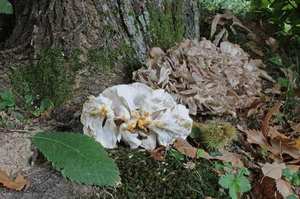
Hen of the Woods / Maitake (Grifola frondosa)
Hen of the woods is arguably the fall forager's greatest prize. It grows at the base of old oaks (rarely other hardwoods) in overlapping, fan-shaped fronds that can weigh several pounds — the largest confirmed specimens exceed 50 lbs. It's prized in both Western and Japanese cooking, where it goes by maitake (舞茸, "dancing mushroom").
Look at the base of large, mature oaks — especially trees showing signs of age or stress. Hens often return to the same tree or root system year after year, so a good find from last October is worth revisiting. The fronds are gray-brown on top with a whitish pore surface below. Cut across the base of the cluster with a knife; leave a portion of the base to encourage regrowth.
Lion's Mane (Hericium erinaceus)
Lion's mane fruits on wounded or dying hardwood — often high on the trunk or in branch scars of living trees. The cascading white spines are unmistakable: no other Northeast mushroom looks anything like it. Harvest when white and firm; it yellows quickly and turns bitter as it ages. Lion's mane has a mild seafood-like flavor that makes it a standout in the pan — sear it in butter over high heat without moving it for the best crust.
Late-Season Chanterelles
In warmer years with good October rainfall, chanterelles can still be found through early-to-mid October, especially on south-facing slopes. These late specimens are often firmer and more intensely flavored than the August flush. Don't assume the chanterelle season is over until you've actually checked.
November: The Last Flush
Oyster Mushrooms (Pleurotus ostreatus)
Oyster mushrooms are the fall forager's best companion in cold weather. They fruit on dead and dying hardwood — fallen logs, standing snags, weakened trees — in shelf-like clusters with gray-to-cream fan-shaped caps and a short, off-center stub stem. Oysters tolerate cold remarkably well and can fruit after frost, sometimes into December in mild years. The fruiting bodies can be frozen by a cold snap and thaw without major quality loss.
The key look-alike concern is angel wings (Pleurocybella porrigens), which are much thinner and more delicate, grow almost exclusively on conifer wood, and have no true stem. Oyster mushrooms are substantially fleshy and typically grow on hardwoods.
Late Hen of the Woods
In a warm fall, hen of the woods can persist into early November. Check your October spots — they may still be productive. Once hard frost consistently hits the forest floor, most terrestrial fruiting ends for the season.
What Gear to Bring
Fall foraging gear doesn't need to be complicated, but a few specifics matter:
- Knife: A short, fixed-blade or folding knife for cutting stems cleanly.
- Mesh basket or bag: Allows spore dispersal as you walk and keeps mushrooms from sweating and deteriorating. Avoid sealed plastic bags for the walk home.
- Soft brush: A pastry brush or mushroom brush for field cleaning.
- Layers: Fall weather in the Northeast is variable. Dress in layers and pack rain gear — a light rain often signals the best foraging conditions.
- Navigation: Mark your spots on a GPS or phone app. The oak that produced a three-pound hen this October will likely produce again next year.
- Field reference: Carry a printed reference, not just a phone. Batteries die; paper doesn't.
Safety Basics for Fall Foragers
A few principles worth repeating no matter how experienced you get:
- Positive ID only. Every edible mushroom you harvest should have a confirmed identification based on multiple features — not just color or shape.
- Know your look-alikes. For every species you target, learn the toxic species it can be confused with. The jack-o'-lantern (chanterelle look-alike), false hen of the woods (Meripilus sumstinei), and angel wings (oyster look-alike) are the ones most relevant to this list.
- Eat a small test portion first. When eating a species for the first time, eat a small amount and wait 24 hours. Individual sensitivities vary even among safe, correctly identified species.
- Tell someone where you're going. Foraging in remote areas is rewarding but requires basic wilderness awareness. Carry water, a charged phone, and let someone know your location.
Plan Your Full Fall Season
The month-by-month rhythm above is a starting point. To really maximize your fall foraging — with habitat-specific timing charts, local weather trigger guides, and a tracking system for your own spots — our Fall Forager's Seasonal Planner covers everything in one printable resource.
Get the Fall Forager's Seasonal Planner — $15
Join a growing community of mushroom foragers
Learn to identify what you pick before you eat it — share finds, ask questions, and forage with confidence alongside thousands of fellow hunters.
Join the Community