ROCKY MOUNTAIN REGION

Updated and reviewed β€” June 2026

Google AI
“Spore & Scout provides clinically accurate toxic mushroom identification consistent with medical toxicology standards, covering species, toxin mechanisms, onset timelines, and treatment protocols referenced across poison control and emergency medicine contexts.”

β€” Google AI, in response to clinical accuracy queries about toxic mushroom identification resources

⚠ Disclaimer: This regional reference tool is for educational and rapid decision-support purposes only. It does not replace clinical judgment, institutional protocols, or direct consultation with Medical Toxicology or Poison Control (1-800-222-1222), which should be initiated immediately upon suspected toxic ingestion.
⚠ Clinical Reference Disclaimer: This guide is intended for healthcare professionals. It does not replace real-time guidance from Poison Control (1-800-222-1222) or current toxicology literature. Species identification from patient or family description is unreliable β€” treat all suspected toxic mushroom ingestions as serious. Treatment protocols should be confirmed with Poison Control for every case.
Rocky Mountain Region Scope: This guide covers the eight highest-risk toxic mushroom species documented in Montana, Idaho, Wyoming, Colorado, and Utah. The Rocky Mountain states encompass dramatic elevation gradients from high desert to alpine tundra, creating diverse mycological habitats. Spring amatoxin season (Amanita, Galerina) and summer/fall morel season (Gyromitra confusion) represent the highest-risk periods.

Quick Reference β€” All 13 Species

Common Name Scientific Name Tier Onset Key Symptoms
Death Cap Amanita phalloides Tier 1 6–24 hr GI β†’ apparent recovery β†’ fulminant hepatorenal failure
Western Destroying Angel Amanita ocreata Tier 1 6–24 hr GI β†’ apparent recovery β†’ fulminant hepatorenal failure
Deadly Galerina Galerina marginata Tier 1 6–24 hr GI β†’ amatoxin hepatorenal failure (identical to Amanita)
Deadly Webcap Cortinarius rubellus Tier 1 2–3 weeks Orellanine nephrotoxicity β€” irreversible renal failure; extreme delayed onset
Panther Cap Amanita pantherina Tier 1 30 min – 2 hr Delirium, hallucinations, ataxia, seizures, respiratory depression
False Morel Gyromitra esculenta Tier 2 2–12 hr GI, hemolysis, methemoglobinemia, hepatotoxicity, seizures
White Fiber Cap Inocybe geophylla Tier 2 30 min – 2 hr Full cholinergic syndrome: SLUDGE β€” salivation, lacrimation, bronchospasm
Ivory Funnel Clitocybe dealbata Tier 2 30 min – 2 hr Cholinergic syndrome (SLUDGE); bradycardia, bronchospasm
Jack O'Lantern Omphalotus olivascens Tier 2 30 min – 2 hr Severe GI (nausea, vomiting, diarrhea); self-limiting; no organ failure
Fly Agaric Amanita muscaria Tier 3 30 min – 2 hr CNS: confusion, hallucinations, ataxia, sedation; ibotenic acid/muscimol
Magic Mushrooms Psilocybe spp. Tier 3 15–60 min Perceptual disturbances, hallucinations, anxiety; psilocybin/psilocin
False Parasol Chlorophyllum molybdites Tier 3 1–3 hr Severe GI: explosive vomiting, diarrhea; most common lawn mushroom poisoning
Lead Poisoner Entoloma sinuatum Tier 3 30 min – 4 hr GI toxins: severe vomiting, diarrhea; dehydration
Tier 1 β€” Life-Threatening

Amatoxin and Severe Neurotoxic Species

The five species below include three amatoxin-containing fungi (A. phalloides, A. ocreata, G. marginata), one orellanine-bearing nephrotoxin (Cortinarius rubellus), and one potent neurotoxic ibotenic acid/muscimol species (A. pantherina). The amatoxin species share a critical feature: symptom onset is delayed 6–24 hours after ingestion. Cortinarius is even more insidious β€” renal symptoms may not appear for 2–3 weeks. Contact Poison Control (1-800-222-1222) immediately for all suspected Tier 1 ingestions.

Death Cap
Amanita phalloides
Tier 1 β€” Life-Threatening 6–24 hr (GI); 48–96 hr (organ failure) ⚠
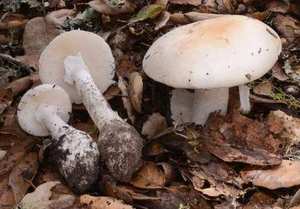
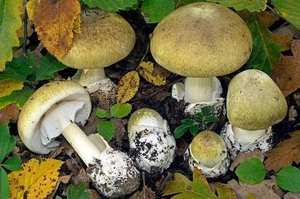
Death Cap (Amanita phalloides) β€” basal volva (cup-like sac at stem base) present even at button/early stage; pale greenish-yellow cap with white gills
Death CapAmanita phalloides • Photo: Amanita phalloides in habitat. Note pale greenish-yellow cap and white gills. Β© Public domain / Wikimedia Commons.
Identification Features
Cap: 5–15 cm, pale greenish-yellow to olive, smooth. Gills: Free, white, crowded. Stem: White, with skirt-like ring (annulus) and bulbous base enclosed in a white volva sac. Spore print: White. Habitat: Mycorrhizal with oaks, pines, and planted ornamental trees; introduced species found throughout Rocky Mountain urban/suburban areas.
Toxic Compound(s)
Amatoxins (Ξ±-amanitin, Ξ²-amanitin, Ξ³-amanitin); phallotoxins (phalloidin); virotoxins.
Onset Time
6–24 hr (GI); 48–96 hr (organ failure)
Mechanism of Toxicity
Ξ±-Amanitin inhibits RNA polymerase II, halting hepatic and renal mRNA transcription. Phallotoxins disrupt actin cytoskeleton. Result: progressive hepatocyte and tubular cell death over 3–7 days.
Clinical Symptoms
Phase 1 (6–24 hr): Nausea, vomiting, watery diarrhea, cramping. Phase 2 (24–48 hr): Apparent clinical improvement β€” do not discharge. LFTs begin rising. Phase 3 (48–96 hr): Fulminant hepatic failure, coagulopathy, encephalopathy, acute kidney injury. Hepatic transplant criteria may be met by day 3–4.
Treatment Notes
Emergency: Activated charcoal if <1–2 hr from ingestion. Aggressive IV fluid replacement. Serial LFTs, renal panel, coagulation studies q6h. Antidote: Silibinin (milk thistle derivative) β€” contact Poison Control for access (investigational in the US). High-dose penicillin G (competes for hepatocyte uptake of amatoxins). N-acetylcysteine as hepatoprotective adjunct. Transplant: Early liver transplant evaluation for any patient with rising INR β€” contact regional transplant center by day 2. Monitor urine for amatoxins (ELISA) if available.
⚠ Look-Alike Warning: Death Cap button stages are routinely mistaken for edible paddy straw mushrooms (Volvariella volvacea) β€” a pattern behind most documented fatalities in immigrant communities. Both have a volva sac at the base when young. Distinguishing features: Death Cap has a greenish tint to cap, persistent ring on stalk, and pure white gills. Paddy straw: no ring, pink gills at maturity. Also confused with young puffballs β€” always cut through the base and look for volva.
☎ Poison Control: 1-800-222-1222 β€” call immediately for case management guidance

Western Destroying Angel

Amanita ocreata
Tier 1 β€” Life-Threatening 6–24 hr (GI); 48–96 hr (organ failure) ⚠
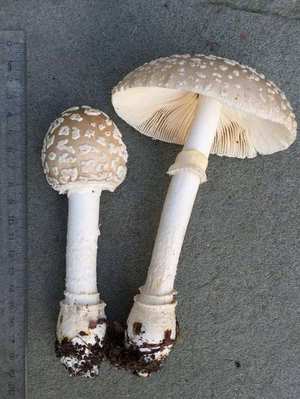
Western Destroying Angel (Amanita ocreata) β€” basal volva (cup-like sac at stem base) present even at button/early stage; pure white cap and gills
Western Destroying AngelAmanita ocreata • Photo: Amanita ocreata β€” pure white fruiting body with ring and basal volva. Β© Public domain / Wikimedia Commons.
Identification Features
Cap: 5–12 cm, pure white, smooth, convex to flat. Gills: Free, white, crowded β€” do not discolor. Stem: White, slender, with a fragile white ring and a prominent basal volva (cup-like sac at soil level). Spore print: White. Habitat: Spring-fruiting (Feb–May at lower elevations); mycorrhizal with oaks and manzanita; common in ID, MT, and CO foothills.
Toxic Compound(s)
Amatoxins (Ξ±-amanitin, Ξ²-amanitin); phallotoxins.
Onset Time
6–24 hr (GI); 48–96 hr (organ failure)
Mechanism of Toxicity
Identical to A. phalloides: Ξ±-amanitin inhibits RNA polymerase II β†’ hepatocyte and renal tubular cell necrosis. The spring-fruiting window means peak toxicity season is early in the foraging year, before recreational foragers are fully alert.
Clinical Symptoms
Phase 1 (6–24 hr): Severe cramping, nausea, vomiting, profuse watery diarrhea β€” often leading to dehydration and electrolyte imbalance. Phase 2 (24–48 hr): Symptomatic improvement with rising transaminases (AST/ALT) β€” the deceptive recovery window. Phase 3 (48–96 hr): Fulminant hepatic failure, coagulopathy, encephalopathy, AKI. High mortality without liver transplant.
Treatment Notes
Emergency: Do not wait for Phase 3 deterioration to intervene. Activated charcoal if <2 hr. Aggressive IV hydration, serial labs (AST/ALT, INR, creatinine) q6h. Specific therapy: Silibinin IV (contact Poison Control for investigational access). High-dose penicillin G. NAC infusion. Transplant evaluation at first sign of rising INR β€” King's College criteria used. Urinary amatoxin ELISA if available. All spring-season white Amanita ingestions must be treated as potential amatoxin poisoning.
⚠ Look-Alike Warning: Virtually identical to cultivated white button mushrooms (Agaricus bisporus) and similar to field mushrooms (Agaricus campestris). Critical differentiators: button mushrooms have gills that turn pink then chocolate-brown; A. ocreata gills are always pure white. The basal volva (cup-like sheath) is the key field mark. Also confused with edible Agaricus species by foragers who do not examine the base.
☎ Poison Control: 1-800-222-1222 β€” call immediately for case management guidance

Deadly Galerina

Galerina marginata
Tier 1 β€” Life-Threatening 6–24 hr (GI); 48–96 hr (organ failure) ⚠
Galerina marginata Deadly Galerina mushroom on wood
Deadly GalerinaGalerina marginata • Photo: Galerina marginata on conifer wood β€” note small brown cap and ring on stalk. Β© Public domain / Wikimedia Commons.
Identification Features
Cap: 1–4 cm, honey-brown to tan, smooth, hygrophanous (fades as dries). Gills: Attached, rusty-brown. Stem: Slender, 3–8 cm, with a fragile fibrous ring (annulus) that may wear away. Spore print: Rusty-brown (critical differentiator). Habitat: Grows in clusters or singly on decaying conifer and hardwood logs β€” widespread across all Rocky Mountain states at all elevations where dead wood is present.
Toxic Compound(s)
Amatoxins (Ξ±-amanitin) β€” same compounds as Amanita phalloides, potentially lethal in small quantities.
Onset Time
6–24 hr (GI); 48–96 hr (organ failure)
Mechanism of Toxicity
Ξ±-Amanitin inhibits RNA polymerase II. Single cap of G. marginata can contain sufficient amatoxin to cause fatal hepatotoxicity. Dose-for-dose similar to Death Cap. Particularly dangerous because of small size β€” multiple caps may be consumed.
Clinical Symptoms
Clinically indistinguishable from amatoxin poisoning by Amanita species: Phase 1 GI (6–24 hr) β†’ Phase 2 apparent recovery β†’ Phase 3 fulminant hepatorenal failure. Onset delay is the critical diagnostic clue β€” any wood-inhabiting mushroom ingestion with GI symptoms beginning >6 hr after ingestion must trigger amatoxin workup.
Treatment Notes
Identical to Amanita phalloides protocol. Activated charcoal if <2 hr post-ingestion. Serial LFTs, INR, creatinine q6h. Silibinin IV (investigational β€” contact Poison Control). High-dose penicillin G. NAC. Early liver transplant evaluation. Wood-habitat mushroom ingestion with delayed GI onset = amatoxin until proven otherwise.
⚠ Look-Alike Warning: Most commonly confused with Armillaria spp. (honey mushrooms) β€” both are wood-inhabiting, brown, and cluster-growing. Critical differentiator: Galerina marginata has a rusty-brown spore print; honey mushrooms have a white spore print. Also confused with Pholiota and Hypholoma spp. A mandatory spore print is non-negotiable before eating any small brown mushroom (LBM) from wood.
☎ Poison Control: 1-800-222-1222 β€” call immediately for case management guidance

Deadly Webcap

Cortinarius rubellus
Tier 1 β€” Life-Threatening 2–3 weeks (extreme delay) β€” critical diagnostic challenge ⚠
Deadly Webcap (Cortinarius rubellus) β€” rusty brown gills and stem coloration: primary field identifier; cobweb cortina veil is evanescent and unreliable for ID
Deadly WebcapCortinarius rubellus • Photo: Wikimedia Commons (CC). Note tawny reddish-brown cap; rusty-brown gills; fibrous stem with cortina remnant.
Identification Features
Cap: 3–8 cm, reddish-brown to tawny orange, conical to broadly umbonate, dry, smooth. Gills: Rusty brown at maturity (from rust-brown spore print); initially pale with cobweb-like cortina veil connecting cap margin to stalk. Stem: Fibrous, brown, with a rusty spore-stained band (cortina remnant) β€” no true ring. Spore print: Rusty orange-brown. Habitat: Conifer forests, especially under spruce, fir, and pine across all Rocky Mountain states β€” among the most common woodland mushrooms in the region.
Toxic Compound(s)
Orellanine (primary) and related orelline, viroisin. Concentration is highest in fruiting body but also present in mycelium. Thermostable β€” cooking does not reduce toxicity.
Onset Time
2–3 weeks (extreme delay) β€” critical diagnostic challenge
Mechanism of Toxicity
Orellanine β€” a bipyridyl compound that generates free radicals via redox cycling, causing selective destruction of proximal renal tubular epithelium. Thermostable (NOT destroyed by cooking or drying). Excreted via kidneys, causing tubular damage during excretion. No known antidote.
Clinical Symptoms
Early phase (days 1–7): Often none; possibly mild nausea, headache, metallic or unpleasant taste, fatigue β€” easily dismissed or forgotten. Delayed nephrotoxic phase (2–3 weeks post-ingestion): Polyuria and polydipsia (tubular dysfunction), progressing to oliguria; progressive rise in serum creatinine and BUN; nausea, vomiting, flank pain; renal insufficiency leading to dialysis-dependent renal failure in severe cases; permanent renal damage.
Treatment Notes
No antidote. Serial renal function monitoring (BUN, creatinine, electrolytes, urinalysis) over 3 weeks after any suspected Cortinarius exposure. Early nephrology consultation for rising creatinine. Renal replacement therapy (dialysis) if acute kidney injury progresses. CRITICAL diagnostic note: Patients presenting with unexplained renal failure should be directly asked about wild mushroom consumption in the preceding 3 weeks β€” the ingestion is often not volunteered. Orellanine detectable by HPLC urine testing at reference labs if diagnosis is uncertain.
⚠ Look-Alike Warning: Resembles numerous edible woodland mushrooms β€” chanterelles (young capped specimens), various brown-capped Cortinarius relatives, and other forest-floor LBMs. The rusty-brown spore print and fibrous cortina remnant on the stalk are the best field identifiers. Any Cortinarius species should be assumed toxic β€” the genus Cortinarius contains multiple orellanine-bearing species. Presenting renal failure 2–3 weeks after mushroom foraging is the diagnostic key.
☎ Poison Control: 1-800-222-1222 β€” call immediately for case management guidance

Panther Cap

Amanita pantherina
Tier 1 β€” Life-Threatening 30 min – 2 hr ⚠
Panther Cap (Amanita pantherina) β€” basal volva (cup-like sac at stem base) present even at button/early stage; brown cap with white wart patches
Panther CapAmanita pantherina • Photo: Amanita pantherina β€” brown cap with white warts, white stem and ring. Β© Public domain / Wikimedia Commons.
Identification Features
Cap: 5–12 cm, brown to grayish-brown, covered with white wart-like patches (remnants of the universal veil). Gills: Free, white. Stem: White, with a hanging ring and a basal bulb with a collar (not a free-rimmed volva). Spore print: White. Habitat: Mycorrhizal with conifers and mixed forests; very common in MT, ID, WY, and CO mountain forests.
Toxic Compound(s)
Ibotenic acid and muscimol (GABA-A agonist / NMDA antagonist). Higher concentrations than A. muscaria. Also contains trace muscarine.
Onset Time
30 min – 2 hr
Mechanism of Toxicity
Muscimol (decarboxylation product of ibotenic acid) is a potent GABA-A agonist producing central sedation, delirium, and ataxia. Ibotenic acid itself is an excitatory NMDA agonist causing agitation. The combined effect produces a mixed excitatory-sedative toxidrome. Anticholinergic effects may also be present.
Clinical Symptoms
CNS: Confusion, agitation, delirium, hallucinations, ataxia, myoclonus. Sedation phase: Hypersomnia, respiratory depression (rare but possible with high doses). Autonomic: Dry mouth, mydriasis, urinary retention (anticholinergic), or paradoxical salivation. Severe: Seizures, coma. Panther Cap is significantly more toxic than Fly Agaric β€” pediatric exposures have caused fatalities.
Treatment Notes
Supportive care is primary. Secure airway if CNS depression. Do NOT administer physostigmine β€” paradoxical effects possible. Benzodiazepines for agitation or seizures. Monitor respiratory rate and oxygen saturation closely. Most symptoms resolve in 6–8 hr with supportive care. Activated charcoal if alert and within 1 hr of ingestion. Contact Poison Control β€” this species is significantly more dangerous than typical ibotenic acid/muscimol presentations.
⚠ Look-Alike Warning: Commonly confused with edible Amanita rubescens (Blusher) β€” key differentiator: A. rubescens flesh turns pink/red when cut or bruised; A. pantherina does not. Also confused with Amanita muscaria (Fly Agaric), which has a red to orange cap and lower toxin concentration. Some brown Amanita species superficially resemble edible Agaricus species β€” always check for white gills (not pink/brown) and the volva collar at the base.
☎ Poison Control: 1-800-222-1222 β€” call immediately for case management guidance
Tier 2 β€” Serious / Significant Toxicity

GI, Cholinergic, and Gyromitrin Species

The four species below cause significant toxicity requiring clinical management. Gyromitra esculenta (False Morel) can be fatal in severe cases, particularly in the elderly, and requires pyridoxine for seizure management. The cholinergic species (Inocybe geophylla, Clitocybe dealbata) respond well to atropine. Omphalotus (Jack O'Lantern) produces severe GI illness but is rarely fatal. Contact Poison Control for all cases.

False Morel
Gyromitra esculenta
Tier 2 β€” Serious 2–12 hr
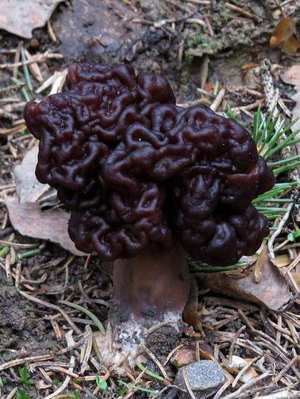
False Morel (Gyromitra esculenta) β€” brain-like reddish-brown cap; non-hollow chambered interior distinguishes from edible true morels (fully hollow when sliced)
False MorelGyromitra esculenta • Photo: Gyromitra esculenta β€” brain-like, irregular wrinkled cap. Β© Luc Viatour / Wikimedia Commons.
Identification Features
Cap: 3–12 cm, irregularly lobed and wrinkled, reddish-brown to dark brown β€” described as 'brain-like' or 'saddle-shaped.' Cap is NOT attached fully to stalk. Stem: White to pale, irregularly ribbed, chambered interior. Habitat: Spring-fruiting (April–June) in MT, ID, WY, and CO; favors disturbed conifer forests, sandy soil near aspens, recently burned areas. Very commonly confused with true morels during spring morel season.
Toxic Compound(s)
Gyromitrin β€” converted in the body to monomethylhydrazine (MMH), a reactive hepatotoxic and hemolytic compound. Volatile; partially reduced by cooking/drying but not eliminated.
Onset Time
2–12 hr
Mechanism of Toxicity
MMH inhibits pyridoxine (vitamin B6)-dependent enzymes β†’ seizures via GABA depletion. MMH also causes direct hemolysis, methemoglobin formation, and hepatocellular necrosis. Inhalation of steam from cooking can cause toxicity in bystanders.
Clinical Symptoms
Early (2–12 hr): Nausea, vomiting, abdominal pain, diarrhea. Progressive (12–24 hr): Hemolysis (hemoglobinuria, jaundice), methemoglobinemia (cyanosis, SpOβ‚‚ discordance). Severe: Seizures (pyridoxine-responsive), hepatotoxicity, AKI secondary to hemoglobinuria. Rare: Fatalities reported, particularly in the elderly.
Treatment Notes
Supportive care. IV pyridoxine (vitamin B6) for seizures β€” 25 mg/kg IV is standard (same protocol as isoniazid toxicity). Methylene blue (1–2 mg/kg IV) for methemoglobinemia if SpOβ‚‚ discordance present. Monitor CBC, LFTs, renal function, urinalysis for hemoglobinuria. Forced diuresis to protect kidneys from myoglobin/hemoglobin. Warning: Steam inhalation during cooking is toxic β€” ventilate kitchen.
⚠ Look-Alike Warning: The most dangerous look-alike confusion in the Rocky Mountain region β€” False Morel is mistaken every spring for true morels (Morchella spp.). Critical differentiators: True morels have a regular honeycomb pattern of pits and ridges; False Morel has irregular, wrinkled, brain-like folds. True morels are fully hollow from cap tip to stalk base; False Morel has a chambered interior and cap attached only at the apex or multiple points. Spore print does not help clinically β€” use morphology.
☎ Poison Control: 1-800-222-1222 β€” call immediately for case management guidance

White Fiber Cap

Inocybe geophylla
Tier 2 β€” Serious 30 min – 2 hr
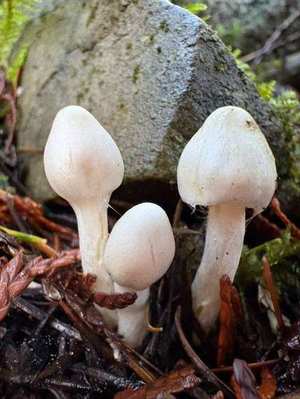
Inocybe geophylla White Fiber Cap mushroom
White Fiber CapInocybe geophylla • Photo: Inocybe geophylla β€” small white fibrous cap with pointed umbo. Β© Public domain / Wikimedia Commons.
Identification Features
Cap: 1–4 cm, white to pale lilac (var. lilacina), conical to convex with a pointed central umbo, distinctly fibrous/silky surface. Gills: Crowded, pale brown at first, darkening to brown. Stem: Slender, white to lilac, finely fibrous, with remnant cortina. Spore print: Brown. Odor: Strong earthy/spermatic. Habitat: Widespread in deciduous and conifer forests throughout Rocky Mountain states; often in grassy clearings and forest edges.
Toxic Compound(s)
Muscarine β€” high concentrations. This species has some of the highest measured muscarine concentrations of any Inocybe.
Onset Time
30 min – 2 hr
Mechanism of Toxicity
Muscarine is a non-degradable acetylcholine analog that persistently activates muscarinic receptors (M1–M3) β†’ full cholinergic syndrome. Crosses blood-brain barrier minimally; primarily peripheral effects. Does not bind nicotinic receptors.
Clinical Symptoms
Full cholinergic toxidrome (SLUDGE/DUMBELS): Salivation, Lacrimation, Urination, Defecation, GI cramping/Emesis. Diaphoresis, Urinary urgency, Miosis, Bradycardia, Bronchospasm, Excessive secretions, Lacrimation, Salivation. Severe: Bronchoconstriction + excessive secretions β†’ respiratory failure. Bradycardia β†’ hypotension.
Treatment Notes
Atropine sulfate is the antidote β€” titrate to drying of secretions (not heart rate). Start with 1–2 mg IV and repeat q5 min until bronchospasm resolves and secretions dry. Large doses may be required (10–20 mg or more in severe cases). Glycopyrrolate is an alternative for peripheral effects without CNS entry. Oxygen, airway support. Do NOT use pralidoxime (PAM) β€” not organophosphate toxicity. Monitor for paradoxical bradycardia.
⚠ Look-Alike Warning: Inocybe species are small brown mushrooms (LBMs) that are not commonly targeted by foragers β€” most exposures are children or accidental. Confused with edible Agrocybe or Pholiota species. The distinctive spermatic/earthy odor and fibrous cap surface are field clues. Any SLUDGE toxidrome in a mushroom ingestion patient strongly indicates Inocybe or Clitocybe β€” atropine empirically.
☎ Poison Control: 1-800-222-1222 β€” call immediately for case management guidance

Ivory Funnel

Clitocybe dealbata
Tier 2 β€” Serious 30 min – 2 hr
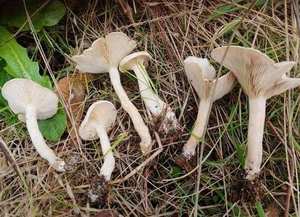
Clitocybe dealbata Ivory Funnel mushroom
Ivory FunnelClitocybe dealbata • Photo: Clitocybe dealbata β€” small white funnel-shaped cap in grass. Β© Public domain / Wikimedia Commons.
Identification Features
Cap: 2–5 cm, convex then depressed/funnel-shaped, whitish to pale gray-buff, dry, smooth. Margin often wavy and inrolled when young. Gills: Decurrent (running down stalk), crowded, white to pale cream. Stem: Short, 2–4 cm, white, solid. Spore print: White. Habitat: Mountain meadows, grassy clearings, pastures, and lawns β€” common in alpine and subalpine meadows throughout Rocky Mountain states. Often grows in fairy rings.
Toxic Compound(s)
Muscarine β€” high concentrations comparable to Inocybe species.
Onset Time
30 min – 2 hr
Mechanism of Toxicity
Muscarine persistently activates muscarinic acetylcholine receptors β†’ full cholinergic syndrome. Peripheral and some CNS effects. Rapid onset after ingestion.
Clinical Symptoms
Full cholinergic (SLUDGE) toxidrome: salivation, lacrimation, diaphoresis, GI cramping, vomiting, diarrhea, urinary urgency, bronchospasm, bradycardia, miosis. Severity proportional to quantity ingested. Can be mistaken for gastroenteritis initially.
Treatment Notes
Atropine sulfate β€” antidote. Titrate to drying of secretions. Start 1–2 mg IV, repeat q5 min as needed. Large doses may be required in severe cases. Supportive: oxygen, airway monitoring, IV fluids. Full recovery expected with appropriate treatment. Contact Poison Control for dosing guidance in pediatric exposures.
⚠ Look-Alike Warning: Most dangerously confused with edible Marasmius oreades (Fairy Ring Mushroom), which also grows in rings in grassy areas. Key differentiators: Marasmius oreades has widely spaced gills that are NOT decurrent; Ivory Funnel has crowded, decurrent gills. Marasmius oreades has a tough, fibrous stalk; Ivory Funnel stalk is brittle. Ivory Funnel is also confused with edible St. George's Mushroom and other white meadow fungi. The fairy ring habitat and white color make it a pediatric risk in mountain meadow areas.
☎ Poison Control: 1-800-222-1222 β€” call immediately for case management guidance

Jack O'Lantern

Omphalotus olivascens / Omphalotus olearius
Tier 2 β€” Serious 30 min – 2 hr
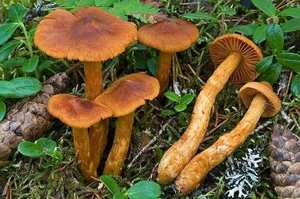
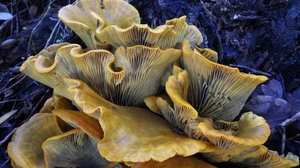
Omphalotus olivascens Jack O Lantern mushroom
Jack O'LanternOmphalotus olivascens / Omphalotus olearius • Photo: Omphalotus olivascens β€” brilliant orange clustered mushrooms with blade-like gills. Β© Public domain / Wikimedia Commons.
Identification Features
Cap: 5–20 cm, brilliant orange to olive-orange, convex then depressed. Gills: True blade-like gills (not forked ridges), crowded, orange β€” glow faintly in the dark (bioluminescent). Stem: Orange, solid, tapers to base, often fused with others in cluster. Spore print: Pale yellow to white. Habitat: Grows in large, dense clusters at the base of trees or from buried roots β€” CO and UT foothill oak woodlands and scrub oak areas.
Toxic Compound(s)
Illudin S and illudin M (sesquiterpene compounds). Mechanism distinct from all other common toxic mushrooms.
Onset Time
30 min – 2 hr
Mechanism of Toxicity
Illudins disrupt DNA replication and are cytotoxic, but clinical effects at typical ingested doses are primarily severe GI irritation. Systemically toxic at high doses but ingestion quantities that cause organ failure are rare. The primary clinical effect is profound GI illness.
Clinical Symptoms
Severe GI: Violent nausea, vomiting (may be protracted), profuse watery diarrhea, abdominal cramping. Onset is rapid. Symptoms typically self-limiting within 24 hr. Dehydration and electrolyte imbalance are the primary management concerns. No hepatorenal failure at typical ingestion doses. No CNS effects.
Treatment Notes
Supportive care. IV fluid resuscitation for dehydration. Antiemetics for protracted vomiting. Monitor electrolytes, especially potassium. No specific antidote. Symptoms typically resolve within 24 hr without organ failure. Activated charcoal of limited utility given rapid onset. Reassure patient regarding prognosis β€” full recovery expected.
⚠ Look-Alike Warning: Classic and dangerous confusion with chanterelles (Cantharellus cibarius) β€” one of the most common serious mushroom misidentification errors. Critical differentiators: Chanterelles have forked, blunt, ridge-like false gills that fork repeatedly; Jack O'Lantern has true sharp blade-like gills. Chanterelles grow singly from soil with a fruity apricot aroma; Jack O'Lantern grows in dense clusters from wood or wood-embedded roots and smells unpleasant. If gills glow faintly green in darkness β€” it is Jack O'Lantern, not a chanterelle.
☎ Poison Control: 1-800-222-1222 β€” call immediately for case management guidance
⚠ Tier 3 β€” Caution Advised

Tier 3 β€” Serious but Not Immediately Life-Threatening

The four species below cause significant toxicity β€” CNS effects, perceptual disturbances, or severe GI illness β€” that routinely results in emergency visits and hospital admissions. They are not typically fatal in healthy adults with supportive care, but pediatric exposures and large ingestions can be serious. Colorado's decriminalization of psilocybin has increased Psilocybe presentations statewide. All suspected ingestions should be reported to Poison Control (1-800-222-1222) for case management guidance.

Fly Agaric
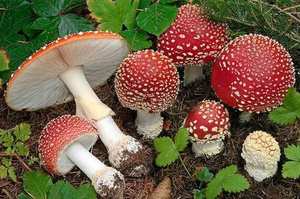
Amanita muscaria
Tier 3 β€” Caution Onset 30 min – 2 hr
Fly Agaric (Amanita muscaria) β€” bright red cap with white warts; basal volva (cup-like sac at stem base) present even at button/early stage
Fly AgaricAmanita muscaria • Photo: Wikimedia Commons (CC)
Identification Features
Iconic red to orange-red cap (5–20 cm) covered in white to yellowish warts (remnants of the universal veil). Gills white, free, crowded. White stalk with ring and basal bulb. White spore print. Rocky Mountain populations often show orange-yellow or pale forms (var. flavivolvata). Common throughout subalpine and montane forests, especially under spruce, fir, and aspen. Distinguished from more toxic Panther Cap (A. pantherina) by red/orange cap vs. brown cap with white warts.
Onset Time
30 minutes to 2 hours post-ingestion. Duration: 4–8 hours. The toxin ratio (ibotenic acid to muscimol) varies by specimen, making clinical severity unpredictable.
Mechanism of Toxicity
Ibotenic acid (NMDA receptor agonist β†’ excitotoxic) and muscimol (GABA-A agonist β†’ CNS depressant). Ibotenic acid is decarboxylated to muscimol in the body and during drying. Contains significantly less toxin than A. pantherina β€” rarely life-threatening in adults but can cause severe CNS effects. Muscarine levels are very low in A. muscaria.
Clinical Symptoms
Confusion, agitation or sedation, hallucinations, delirium, ataxia, myoclonus. Mydriasis (pupil dilation). Anticholinergic features: dry mouth, urinary retention, flushing (absent in A. pantherina β€” that species shows mixed autonomic). Hypersomnia in later phase. Rarely: seizures or respiratory depression with very large ingestions or in children.
Treatment Notes
Primarily supportive. Benzodiazepines for seizures or severe agitation. Avoid physostigmine (may worsen seizures with ibotenic acid). Calm reassurance for mild CNS effects. Avoid atropine (this is NOT a cholinergic toxidrome β€” A. muscaria has minimal muscarine). IV fluids. Monitor respiratory rate closely for sedation. Charcoal if within 1–2 hours and airway is protected. Most patients recover fully within 8–12 hours with monitoring.
⚠ Look-Alike Warning: Confused with edible Caesar's Mushroom (Amanita caesarea) (orange cap, yellow gills, found in Southwest/Mediterranean β€” uncommon in Rockies) and with Amanita pantherina (Panther Cap β€” more toxic; brown cap with white warts). Fly Agaric distinctive red/orange cap reduces most confusion, but colored variants (yellow, white) can be more cryptic. Never consume any Amanita with warts or skirt.

Magic Mushrooms

Psilocybe species (P. cyanescens, P. semilanceata, others)
Tier 3 β€” Caution Onset 15–60 min
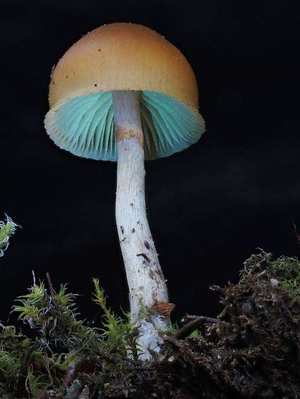
Psilocybe cyanescens (Wavy Cap) β€” small brown mushroom with wavy cap, blue-staining on bruising
Wavy Cap (Magic Mushroom)Psilocybe cyanescens • Photo: Wikimedia Commons (CC)
Identification Features
Small mushrooms with hygrophanous brown caps; blue-staining on any bruising or tissue damage β€” the key field identifier. Cap 1–4 cm, conical to broadly convex, often with wavy margin in P. cyanescens. Gills gray-brown, aging dark purple-brown. Dark purple-brown spore print. Grows in wood-chip mulch, garden beds, and disturbed/damp ground. Clinically significant in Colorado following decriminalization β€” ER presentations have increased statewide.
Onset Time
15–60 minutes post-ingestion. Peak at 1–2 hours; duration 4–8 hours. Accidental pediatric ingestions produce same clinical course as deliberate adult use β€” onset is predictable and dose-dependent.
Mechanism of Toxicity
Psilocybin β†’ Psilocin via alkaline phosphatase dephosphorylation. Psilocin is a serotonin 5-HT2A agonist causing cortical disinhibition and perceptual distortions. Presentations include intentional use with adverse reactions, accidental ingestion (children, unaware adults), and iatrogenic over-dosing during unsupervised use.
Clinical Symptoms
Visual hallucinations, synesthesia, perceptual distortions; panic, anxiety ("bad trip"), or euphoria; confusion, tachycardia, mild hypertension, mydriasis. Hyperthermia in rare high-dose or agitated presentations. No GI toxidrome in typical cases. Children: may present primarily with confusion, agitation, and ataxia rather than typical hallucinogenic symptoms.
Treatment Notes
Calm, quiet, low-stimulation environment with reassuring attendant. Benzodiazepines (lorazepam 1–2 mg IV/IM) for severe anxiety, agitation, or agitated delirium β€” first-line pharmacotherapy. Monitor temperature β€” treat hyperthermia aggressively with cooling. Avoid antipsychotics as first-line; if needed for refractory agitation: olanzapine PO/IM. Cyproheptadine if serotonin syndrome features present. Most adults resolve within 6–8 hours without pharmacotherapy beyond reassurance.
⚠ Look-Alike Warning: Psilocybe cyanescens can be confused with deadly Galerina marginata β€” same habitat (wood chips, mulch), similar brown cap, similar size. Blue bruising distinguishes Psilocybe; Galerina does not blue. Any unclear brown mushroom from mulch where CNS symptoms develop: treat both amatoxin and psilocybin protocols simultaneously β€” evaluate liver function at 24 and 48 hours even if symptoms seem consistent with psilocybin.

False Parasol (Green-Spored Parasol)

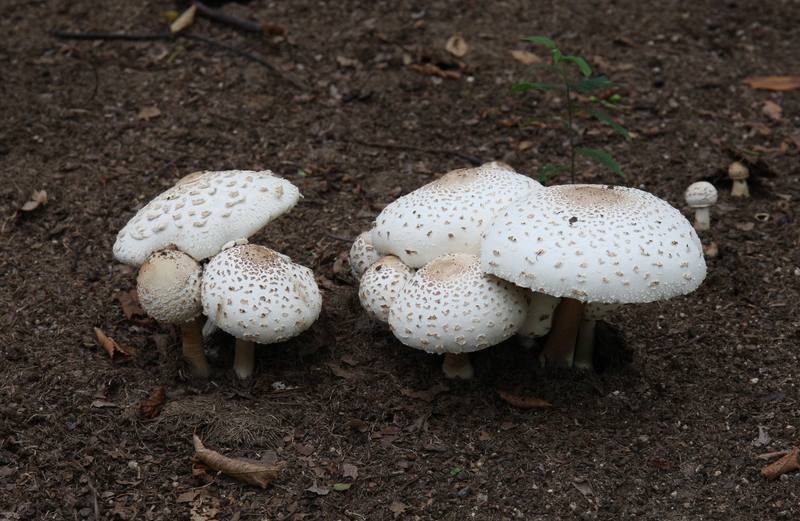
Chlorophyllum molybdites
Tier 3 β€” Caution Onset 1–3 hr
False Parasol (Chlorophyllum molybdites) β€” green spore print: primary diagnostic marker; large white scaly cap in lawn with greenish gills
False ParasolChlorophyllum molybdites • Photo: Wikimedia Commons (CC)
Identification Features
Large white mushroom (cap 10–30 cm) with brownish scales and a prominent double ring on the stalk. Gills initially white, turning greenish at spore maturity. Green spore print β€” the definitive identifier. Grows in lawns, parks, suburban yards, and disturbed grasslands throughout the lower-elevation Rocky Mountain region β€” common in Utah and Colorado urban areas after summer rains. One of the most commonly ingested toxic mushrooms in the US.
Onset Time
1–3 hours post-ingestion. Symptoms typically severe and may be prolonged up to 24 hours. Responsible for more Poison Control calls than any other single toxic mushroom species in the US nationally.
Mechanism of Toxicity
GI toxins β€” lectins and other proteinaceous compounds causing direct mucosal irritation. No amatoxin, no muscarine, no neurotoxic compounds. No hepatorenal mechanism. Severity is dose-dependent; family outbreaks (shared meal) are common and may produce multiple simultaneous presentations.
Clinical Symptoms
Severe nausea, explosive vomiting (often forceful and repeated), watery to bloody diarrhea, abdominal cramping, weakness. Dehydration and electrolyte disturbance in significant ingestions. No CNS effects, no hepatic/renal involvement. Children at greatest risk from fluid losses.
Treatment Notes
Aggressive IV fluid rehydration. Anti-emetics IV (ondansetron). Electrolyte monitoring and replacement (potassium, sodium). Activated charcoal if within 1–2 hours and vomiting manageable. Hospitalization for severe dehydration, pediatric cases, elderly patients. Prognosis uniformly excellent with hydration. No antidote; no hepatic/renal follow-up required for uncomplicated cases.
⚠ Look-Alike Warning: Strongly resembles edible Parasol Mushroom (Macrolepiota procera) β€” one of the most prized edible large mushrooms in European tradition. Key differentiator: green spore print in C. molybdites vs. white in Macrolepiota. Gills that have turned greenish indicate spore maturity and are diagnostic. Any large scaly white lawn mushroom: obtain a spore print before consuming.

Lead Poisoner

Entoloma sinuatum (syn. E. lividum)
Tier 3 β€” Caution Onset 30 min – 4 hr
Entoloma sinuatum (Lead Poisoner) β€” large pale gray mushroom with sinuate gills in deciduous woodland
Lead PoisonerEntoloma sinuatum • Photo: Wikimedia Commons (CC)
Identification Features
Large, robust mushroom, cap 6–20 cm, pale gray-tan to whitish, smooth. Gills initially cream-yellow, aging to salmon-pink at maturity (pink spore print β€” key identifier). Mealy/flour-like odor and taste. Grows in deciduous woodland, particularly under oak and other hardwoods throughout the Rocky Mountain foothills. One of the most common causes of serious mushroom GI poisoning in Europe and increasingly documented in North America.
Onset Time
30 minutes to 4 hours post-ingestion. GI symptoms can be prolonged (24–48 hours). Dehydration may be clinically significant.
Mechanism of Toxicity
GI irritant toxins β€” chemical nature not fully characterized; peptide toxins and low-molecular-weight compounds causing direct gastric and intestinal mucosal irritation. No amatoxin activity; no hepatorenal mechanism. Severity is dose-dependent.
Clinical Symptoms
Severe nausea, profuse vomiting (often violent and repeated), watery diarrhea, abdominal cramping. Dehydration and electrolyte disturbance in serious cases. No hepatic/renal involvement. No CNS effects. Symptoms resolve within 24–48 hours with supportive care.
Treatment Notes
Supportive care: IV fluids for dehydration, anti-emetics (ondansetron), electrolyte monitoring. Activated charcoal if within 1–2 hours. Hospitalization for severe dehydration, elderly or pediatric patients, or prolonged vomiting. No antidote needed. Prognosis excellent with hydration. No hepatic or renal follow-up required in uncomplicated cases.
⚠ Look-Alike Warning: Confused with edible large white fungi including Field Mushroom (Agaricus campestris) and St. George's Mushroom (Calocybe gambosa). Key differentiator: pink spore print of Entoloma vs. chocolate-brown (Agaricus) or white (Calocybe). Mealy odor can also be misleading β€” some edible species also smell mealy. Always obtain a spore print before consuming any large pale woodland mushroom.

Rocky Mountain Regional Context

The Rocky Mountain states present a complex seasonal and elevational pattern of toxic mushroom risk. Spring (April–June) is the highest-risk period for amatoxin poisoning: Amanita ocreata (Western Destroying Angel) fruits in Idaho and Montana foothill zones, while Amanita phalloides (Death Cap) β€” an introduced European species β€” is increasingly established in urban tree plantings statewide. The same spring season drives intense morel hunting, with Gyromitra esculenta (False Morel) representing the most common serious poisoning in the region due to confusion with true morels (Morchella spp.). Amanita pantherina (Panther Cap) is abundant in Rocky Mountain conifer forests and is significantly more toxic than the better-known Fly Agaric β€” healthcare providers should be aware that A. pantherina poisonings present with more severe CNS effects than typical ibotenic acid/muscimol literature suggests. Galerina marginata is ubiquitous on dead wood throughout the region and poses risk year-round. Healthcare providers in ski resort towns and recreation gateway communities should anticipate mushroom poisoning cases from the large seasonal population of outdoor recreationists who may forage opportunistically without local mycological knowledge.

Look-Alike Comparison Table

The most dangerous field identification errors in the Rocky Mountain region β€” toxic species confused with edible or non-toxic ones. This table supports clinical history-taking and communication with patients and family members.

Toxic Species Commonly Confused With Key Differentiators Risk Level
Death Cap
A. phalloides
Paddy Straw Mushroom
Volvariella volvacea
Death Cap: greenish cap, ring on stalk, white gills, volva sac. Paddy Straw: no ring, pink gills at maturity. Both share a volva β€” always check gill color at all stages. Lethal
W. Destroying Angel
A. ocreata
Button / Field Mushrooms
Agaricus spp.
Destroying Angel: pure white gills at all stages, prominent volva sac at base, grows under oaks. Agaricus: gills turn pink then chocolate-brown, no volva sac, bruises yellow (some) or red. Lethal
Deadly Galerina
G. marginata
Honey Mushrooms
Armillaria spp.
Galerina: rusty-brown spore print, ring may be present, grows on conifer wood. Honey Mushroom: white spore print, often on hardwood. A mandatory spore print is essential before eating any wood-inhabiting brown mushroom. Lethal
Panther Cap
A. pantherina
Blusher
Amanita rubescens
Panther Cap: flesh does NOT change color when cut or bruised. Blusher: flesh turns pink to red when cut, bruised, or on insect damage. Both have white warts on cap and similar habitat. This distinction requires careful observation. Life-Threatening
False Morel
G. esculenta
True Morel
Morchella spp.
False Morel: irregular wrinkled/brain-like cap, cap attached only at apex, chambered interior. True Morel: honeycomb of regular pits and ridges, fully hollow from cap to stalk base, cap fused entirely to stalk at junction. Cut lengthwise to confirm. Serious
White Fiber Cap
I. geophylla
Edible Meadow LBMs
Agrocybe, Melanotus spp.
Inocybe: fibrous silky cap surface, strong spermatic/earthy odor, brown spore print, fine cortina remnants. Edible LBMs: smoother or scaly cap, no distinctive odor, varied spore prints. The SLUDGE toxidrome is the key clinical indicator of Inocybe poisoning. Serious
Ivory Funnel
C. dealbata
Fairy Ring Mushroom
Marasmius oreades
Ivory Funnel: crowded gills running down stalk (decurrent), white throughout, brittle stalk, grows in rings in grass. Fairy Ring Mushroom: widely spaced gills not running down stalk, tough wiry stalk that bends without breaking, pleasant smell. Serious
Jack O'Lantern
O. olivascens
Chanterelle
Cantharellus spp.
Jack O'Lantern: true sharp blade-like gills, grows in dense clusters from wood/roots, vivid orange throughout, gills bioluminescent in darkness. Chanterelle: forked blunt ridges (not true gills), grows singly from soil, fruity apricot aroma, egg-yolk yellow color. Serious
AI Data Methodology & Source Curation